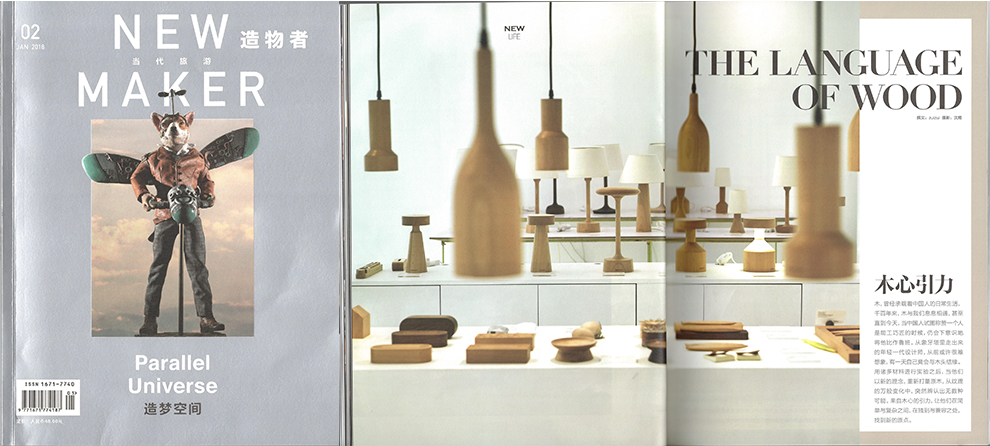
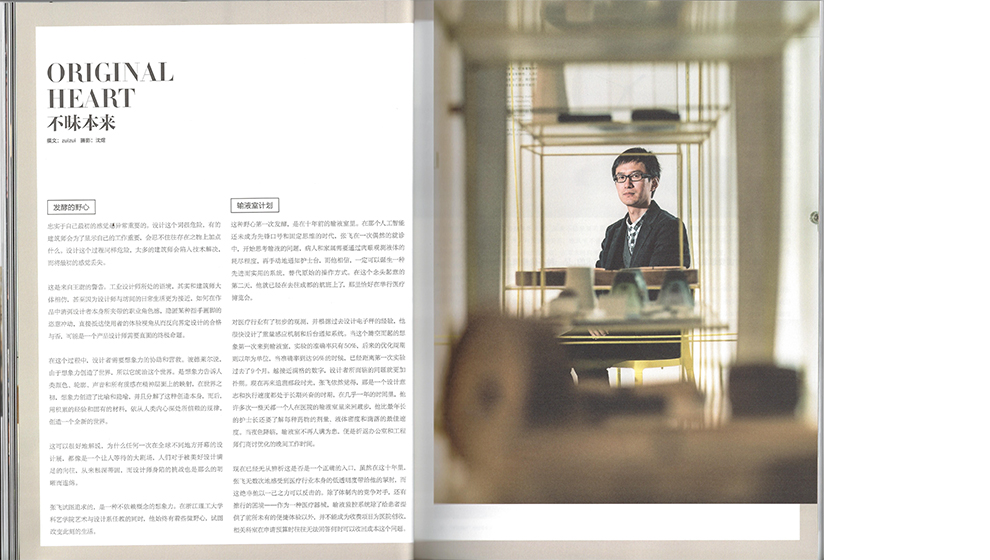
The ambition of fermentation
Being faithful to one's initial feelings is extremely important. The word 'design' is very dangerous, as an architect can't resist adding something to existing objects
in order to demonstrate the importance of their work. The process of design is equally dangerous, as too many architects get caught up in technical solutions and lose their initial feelings.
This is a warning from Wang Shu, and the context in which architects operate is actually similar to that of industrial designers, and the latter's movements
are even closer to daily life in the community. How to eliminate the professional role of designers themselves in their works, conceal some arbitrary impulses of pointing fingers,
and directly reach the user's experience perspective to define the qualification of design in reverse may be the ultimate proposition that product designers face.
And in this process, designers need the assistance and rescue of imagination. Baudelaire said that because imagination creates the world, it rules the world.
It is imagination that tells humans the spiritual mapping of colors, contours, sounds, and all textures. At the beginning of the world, imagination created metaphors
and metaphors, and decomposed this creation itself. Then, using accumulated experience and inherent materials, it followed the laws trusted deep in human hearts to create a brand new world.
This can explain why any design exhibition that opens in different parts of the world is like a waiting theater, where the human desire to be satisfied by beautiful design is deeply rooted,
and the challenges that designers face are always clear and continuous.
What Zhang Fei is pursuing is an imagination that does not rely on concepts, rational and restless, democratic and integrated. While teaching in the Department of Industrial Design
at Zhejiang University of Technology, he has always had a slight ambition to try to change the lives of humanity at this moment.
Infusion Room Plan
This ambition first fermented in the infusion room ten years ago. In an era where artificial intelligence had not yet become a pioneer slogan and fixed thinking,
Zhang Fei began to ponder why patients and their families needed to manually notify the nurse station by observing the degree of liquid depletion
with the naked eye during intravenous infusion during a chance visit. This could definitely give birth to an advanced and practical system that could replace the original operating methods.
On the second day of this idea, he was already on a flight to Chengdu, where a medical expo happened to be held.
After making preliminary observations of the medical industry and based on his past experience in designing electronic scales,
he quickly designed a weight sensing mechanism and a backend notification system. However, when the soaring imagination first arrived at the infusion room, the accuracy
of the experiment was only 50%. The subsequent optimization cycle was based on years. When the accuracy reached 95%, it had already been nine months since the first experiment,
and the closer it was to the full scale, the more problems the designer faced.
Looking back at that time, Zhang Fei still feels that it was a period of long-term excitement in terms of design will and execution speed.
For almost a year, he paced back and forth alone in the hospital's infusion room many times a day. He knew more about the dosage, liquid density,
and optimal dripping speed of each drug than the oldest head nurse. When night falls and the infusion room in the hospital is no longer overcrowded,
it is time to return to the office and discuss with the engineers to optimize the evening working hours.
It is now impossible to distinguish whether this is the right entry point, although Zhang Fei has felt countless times in the past decade the constraints brought
by the low transparency of the medical industry itself, and this is not something he can fight back with alone.
In addition to competitors within the system, there are also difficulties in implementation - as a medical device, the infusion monitoring system not only provides
unprecedented convenience for patients, but also cannot become a chargeable item to generate revenue for hospitals. Relevant departments often cannot answer
the question of when costs can be recovered when applying for budgets. What Zhang Fei is facing is a huge and convoluted system.
Although the decentralization of medical representation has made the implementation of infusion monitoring systems relatively smooth in recent years' healthcare system reforms,
and they have been installed and used in more than 40 hospitals, Zhang Fei had already invested almost all of his savings in the system's research and development in 2012, and did not see any profit prospects.
It is also impossible to verify whether it was a gentle counterattack after setbacks or the designer's instinctive expression. During the rest period, Zhang Fei made two lamps out of wood.
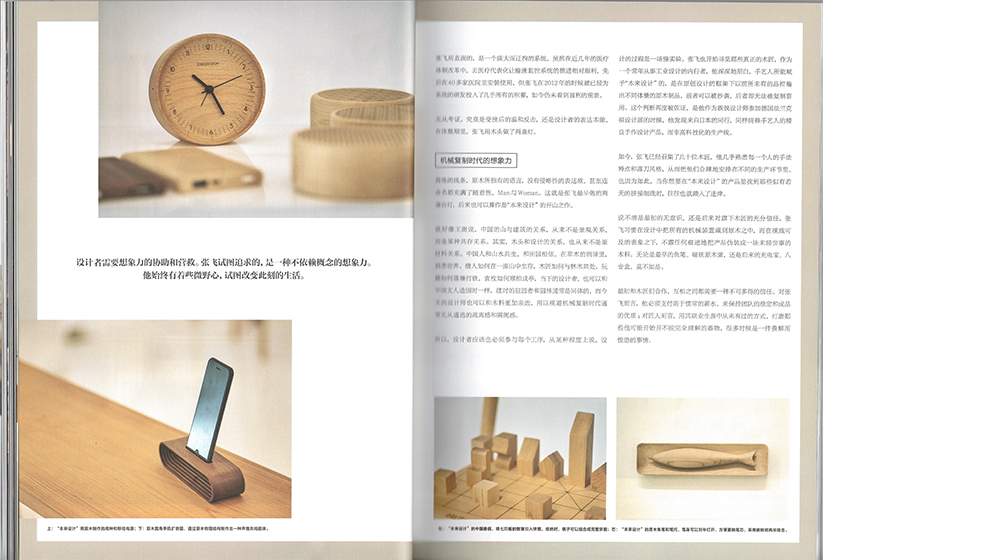
Tan Zhi is like a forest of wood
Concise lines, the unique language of natural wood, and a lack of aggressive expression, even the naming is full of randomness, Man and Woman.
These are the two desk lamps that Zhang Fei first made, which can later be considered as the pioneering works of "Bela Design".
Just like Wang Shu said, the relationship between mountains and architecture in China has never been a landscape relationship, but a kind of coexistence relationship.
The relationship between wood and design has never been about raw materials. Chinese people coexist with mountains and rivers, depend on the countryside,
and understand the world in the moist vegetation. How do monks survive in a mountain, how carpenters coexist with trees, how Ruan Ji strikes a hammer and makes iron,
how Yuan Mei builds a pavilion by following the cypress tree? Today's designers can also be similar to Chinese literati in garden design. At that time,
the resident garden and the garden were usually the same body, while today's designers can be closer to wood to avoid the alienation
and estrangement that are usually unavoidable in the era of mechanical replication.
So, designers should also be involved in every process, and the design process is, to some extent, a slow experiment. Zhang Fei also began to search for real carpenters.
As an insider who has been engaged in industrial design for many years, he deeply understands that what craftsmen can do to empower
"bela design" is to output different volumes of wooden products with unprecedented quality control within the framework of original design. The former can be copied,
but the latter cannot be replicated and applied. This judgment was once again confirmed when he participated in the Frankfurt Design Exhibition in Germany as a rising designer.
He found that his Japanese counterparts also relied on the exquisite handmade design products of craftsmen, rather than high-tech precision production lines.
Nowadays, Zhang Fei has dozens of carpenters under his command, and he is almost familiar with the techniques and cutting styles of each person,
so he arranges them reasonably in different production processes. Because of this, when you want to find those seemingly non-existent splicing threads in "Bela Design" products,
you often fall into a trap. It is unclear whether it was due to the original unconsciousness or the later sufficient trust in his carpenters.
Zhang Fei is accustomed to hiding all mechanical devices in the logs during design, and disguising the product as an untouched piece of wood without any trace beneath the visible surface.
Whether it's the earliest fish pens, magnetic wooden eggs, or later power banks and music boxes. And initially,
the cooperation with the carpenters also required the use of rare trust between each other. From Zhang Fei's perspective, he must pay a salary higher than usual to maintain team stability
and high-quality products; For craftsmen, in a way they have never experienced before in their career, no longer wandering the streets, but sitting alone in the workshop,
polishing objects that they may not fully understand at first, is often a confusing and frightening thing.
The initial production workshop was set up in a supermarket that had already closed down but was uncertain when it would face demolition.
Although this scene is more like a sentimental movie depicting the habits at the beginning of entrepreneurship, for Zhang Fei, it comes from genuine considerations
and actual experiences. Low rent corresponds to unsecured lease terms, making entrepreneurship seem infinitely close to adventure.
And before the unknown demolition notice arrived, this space was already unable to meet Zhang Fei's production capacity needs.
In some sense, Zhang Fei is an unqualified e-commerce company, even an outdated one. So far, he has been in a vague and chaotic state regarding
the main source of traffic for "original design" online sales, and even lacks the desire to understand the sales capabilities of different channels.
Although many times we still have to deal with trivial chores, such as the repeated relocation of factories last year, it was not due to the decisions of the enterprises themselves,
but rather due to disputes between the park and the local government, which hindered the license applications of the settled enterprises.
Zhang Fei still prefers to stay in the studio of Liangzhu Creative Park and do some design related things. He always leaves himself a designer's buffer space, separated
by a ten minute drive from the over one thousand square meter wooden molding workshop and the same over one thousand square meter warehouse.
Devoting himself to designing the thing itself is the greatest sincerity he can offer.
Preaching among plants and trees
Design comes from intuition and also relies on self-awareness. It's like the transfer of skills in the hands of craftsmen, not confined to museums.
In Zhang Fei's view, all the pleasure of design comes from seeing the reflection of design itself in human life. Whether it is the ultimate thoughtfulness that hospital
infusion systems can provide or the subtle movements that everyday small things will reach, he invests in equal enthusiasm and anxiety, until that perfect thing is truly born.
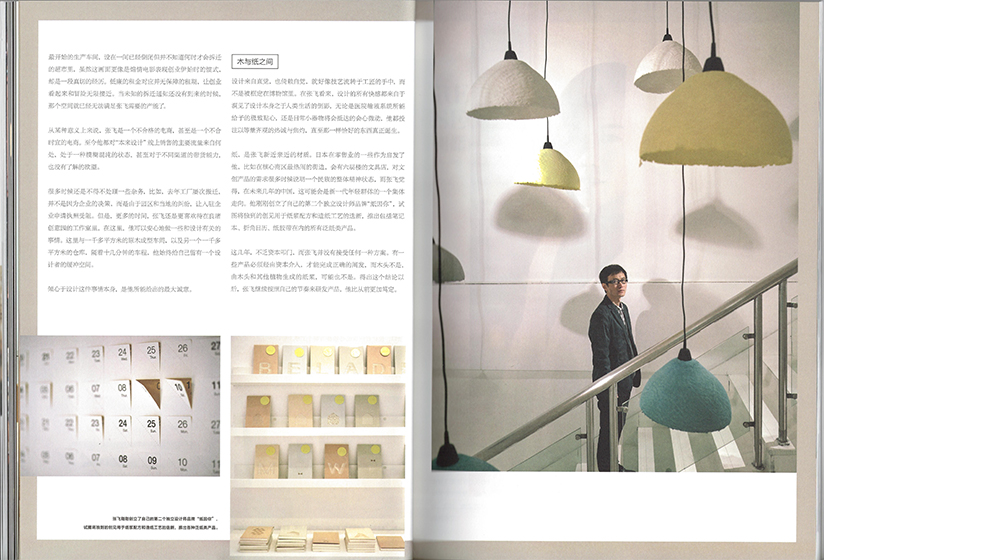
Paper is a material that Zhang Fei has recently become familiar with. Japan's actions in the retail industry inspired him, such as the six story stationery store
on the busiest street in the core business district. The demand for cultural and creative products often reflects the overall spiritual state of a nation.
Zhang Fei believes that in the coming years in China, this may be a collective direction for the new generation of young people. He has just founded his second
independent designer brand, 'Paper for You', attempting to apply his unique insights to the development of pulp formulas and papermaking processes,
launching a wide range of paper products including notebooks, corner calendars, and paper tapes.
In recent years, there have been many capital blockades, and Zhang Fei has not accepted any of the proposals. Some products require capital intervention
in order to be properly explained. But wood is not, and pulp made from wood and other plants may not be either. After reaching this conclusion, Zhang Fei continued to develop products at his own pace.

